Structured Like a Statue: The French Cut That Taught American Women How to Command a Room
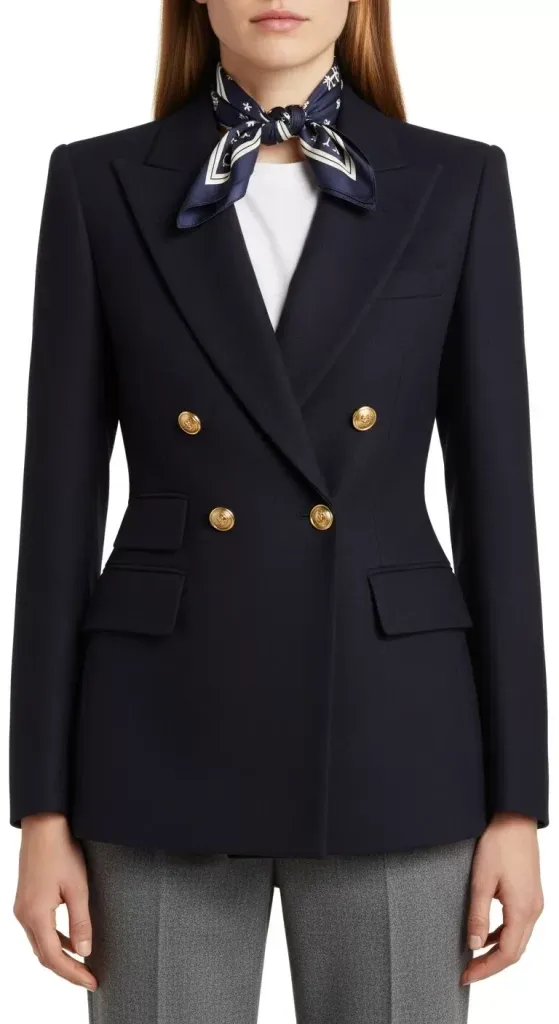
Photo: structured navy blazer woman power dressing editorial fashion, via thedailyallure.com
There is a particular moment, familiar to anyone who has ever dressed for a hearing, a boardroom, or a courtroom, when the jacket goes on and the posture changes. The shoulders settle. The chin lifts. Whatever doubt was there a minute ago has been, if not erased, at least tailored into something more manageable.
We at Haus of Lafayette have long suspected that this transformation has a genealogy — and that it runs, improbably, through a French aristocrat who never held elected office on these shores.
The Original Import
When the Marquis de Lafayette arrived in America in 1777, he brought with him more than military ambition. He brought a cut. The fitted coat, the precise collar, the studied restraint of French military tailoring stood in deliberate contrast to the looser provincial dress of the colonies. To look at Lafayette was to understand that clothing could function as argument — that a silhouette could announce seriousness before a word was spoken.
American politicians noticed. From the early republic onward, the most formal occasions in Washington called for European structure, even as daily American dress drifted toward comfort and pragmatism. The pattern was established: we dress like ourselves on ordinary days and like Paris when it counts.
The Capitol Hill Effect
Walk the halls of Congress today and you will see the inheritance in its modern form. The structured blazer with a nipped waist. The shoulder that holds its line without padding doing all the work. The trousers with a break so deliberate it reads as punctuation.
American power dressing has cycled through phases — the armor of the 1980s, the softness of the 2010s — but the constant is European construction. When an American woman needs to be taken seriously in a room where she is outnumbered, she does not reach for ease. She reaches for structure. And structure, in the Western canon of dress, has always been French.
This is not an accident of fashion. It is a cultural reflex. Authority in America has historically been coded as European formality — the very thing our founders both rebelled against and quietly imitated. Lafayette, the Frenchman who fought for American independence, is the perfect emblem of the contradiction: we borrowed the enemy's tailoring to fight the enemy.
Shopping the Silhouette
For the reader who wants that authority without the archival price tag, the principles are simple and purchasable:
- The shoulder must fit. This is non-negotiable. A jacket's entire message lives at the shoulder seam; everything else can be altered, but this is the foundation.
- Structure over softness. Look for interior canvas, a substantial lapel roll, and a hem that sits below the hip bone. Knit blazers are comfortable; they are not arguments.
- A defined waist. Whether built in or created by a tailor, the hourglass line is what separates dressed from wearing clothes.
- The trouser break. A single, clean break at the shoe. Nothing pooling, nothing floating.
- Neutrals with weight. Navy, charcoal, camel, ivory. The colors that photograph as conviction.
Mid-range American labels — Theory, Khaite's more accessible cousins, Club Monaco in its better seasons — offer the bones. A good alterations budget completes the sentence.
Why It Endures
Fashion writers love to declare power dressing dead, usually right before an election cycle proves otherwise. The structured jacket persists because the need it serves persists. In rooms where women are still measured against a default, the silhouette borrowed from a French revolutionary — who fought, remember, for a country that was not his own — remains the most efficient way to say I belong here.
Lafayette gave us the cut. What we do with it is, as ever, the American part.