Gilded Mirrors and Herringbone Floors: How the Parisian Fitting Room Became America's Best Sales Tool
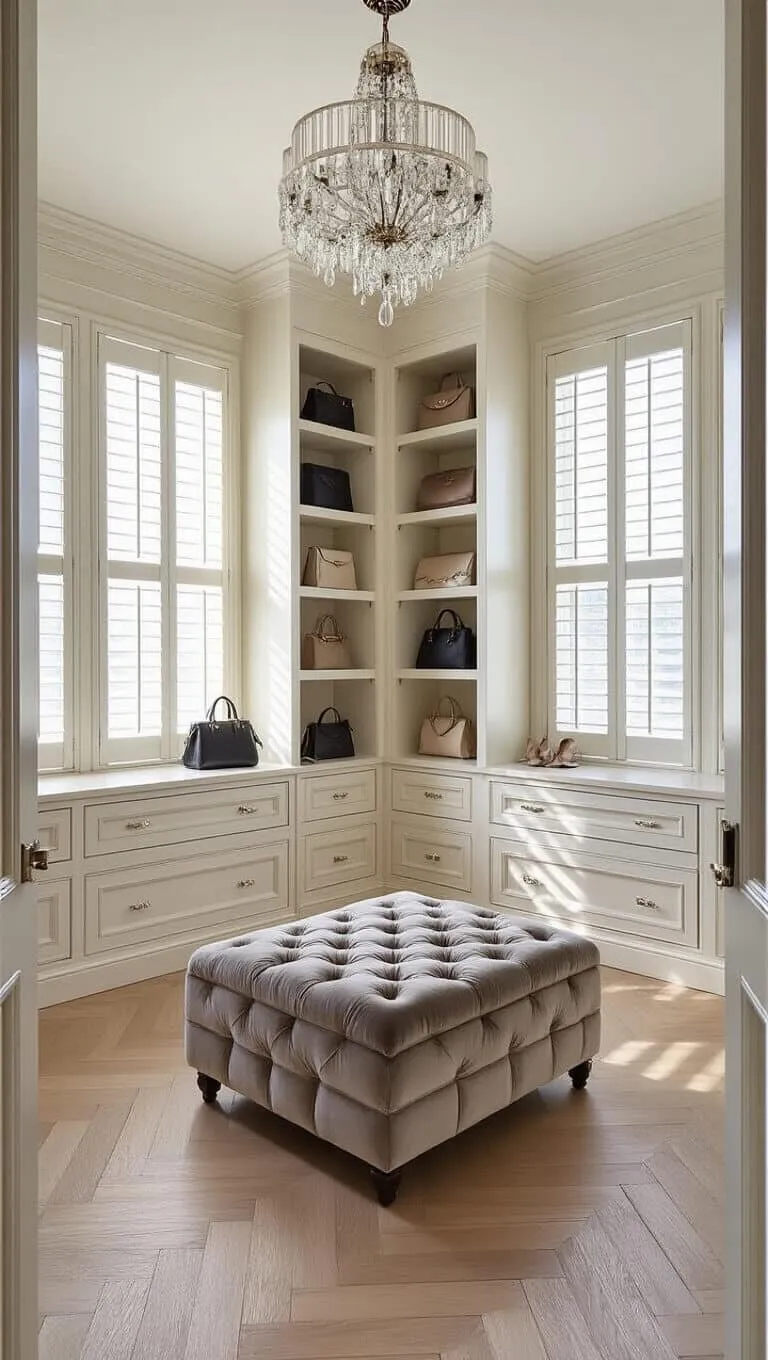
Photo: luxury boutique fitting room with gilded mirror and herringbone floor, via hammockbug.com
There is a moment, familiar to anyone who has shopped in the Marais or along Rome's Via del Governo Vecchio, when the curtain draws back and the mirror does the selling. Not the salesperson. Not the price tag. The mirror — tall, gilded, slightly imperfect — and the floor beneath it, laid in herringbone parquet that has absorbed a century of heels.
American retail, after a decade of optimizing everything except the experience of getting dressed, has noticed.
The Room Is the Argument
Walk into a certain breed of new American boutique — in the Marigny of New Orleans, along Portland's Alberta corridor, in the quieter stretches of Brooklyn — and you may find yourself momentarily confused about which continent you're on. A marble-topped console. A crystal sconce casting warm, flattering light where fluorescent tubes once hummed. An espresso, unasked for, arriving on a small silver tray.
This is not nostalgia. It is strategy.
The fitting room has become the last contested territory between physical retail and the infinite shelf of e-commerce. A shopper can compare prices from her phone in under a minute; she cannot compare the way a bias-cut dress moves when she turns toward a mirror that flatters rather than interrogates. Boutique owners have begun to speak of the fitting room not as a utility but as the store's central argument — the one thing a website cannot replicate.
"I stopped thinking of it as where we process sales and started thinking of it as where we make our case," says one owner of a Louisiana boutique who recently gutted her back-of-house to install a vintage Louis Philippe mirror sourced from an estate sale in the Garden District. "The dress is the same dress. The room changes what the dress means."
The Apartment, Not the Store
The design language being borrowed is distinctly Parisian, and deliberately so. Rather than the white-box minimalism that dominated American concept stores through the 2010s, the new model resembles a private apartment — a salon one has been granted entry to. Herringbone floors. Curtain panels in heavy linen. A single upholstered chair in the corner, positioned the way a friend's chair would be: for leaning, for watching, for waiting with a cappuccino.
The logic is psychological as much as aesthetic. A fitting room that resembles a bedroom closet invites the shopper to imagine the garment in her own life, her own morning, her own apartment. A fitting room that resembles a hospital corridor invites her to imagine the return shipping label.
There is also the matter of light — the most underrated instrument in retail. Warm, diffused lighting at 2700 Kelvin renders skin kindly and fabric truthfully. The overhead fluorescent, long the default of American retail, does neither. It is telling that some of the most successful new boutiques have spent more per square foot on lighting and mirrors than on fixtures.
Espresso as Commerce
The service rituals matter too. Offering coffee in a fitting-room context is not hospitality theater; it is a timer. A shopper who accepts an espresso has, consciously or not, agreed to stay. She has entered a transaction of time rather than mere currency. And time, in physical retail, is the scarcest and most valuable inventory.
Some owners have gone further — private appointments, a dedicated attendant, alterations promised before the customer leaves the building. These are the old-world salon customs, translated into an American idiom of efficiency and warmth. The customer is not merely served; she is hosted.
What the Big Boxes Cannot Copy
The obvious question: if this works, won't the chains simply copy it? Some will try. But the apartment-like fitting room resists franchising precisely because its power lies in specificity — the mirror with a provenance, the floor with a wear pattern, the owner who remembers that the customer in the second room prefers her sleeves shortened.
E-commerce won the transaction. The Parisian fitting room, transplanted to American soil, is contesting the transformation. Because the truth every boutique owner in this quiet movement understands is that a woman does not remember what she bought. She remembers how the room felt when she saw herself in it.
And a gilded mirror, it turns out, is very hard to return.