The Name on the Door: What America Really Buys When It Buys 'French'
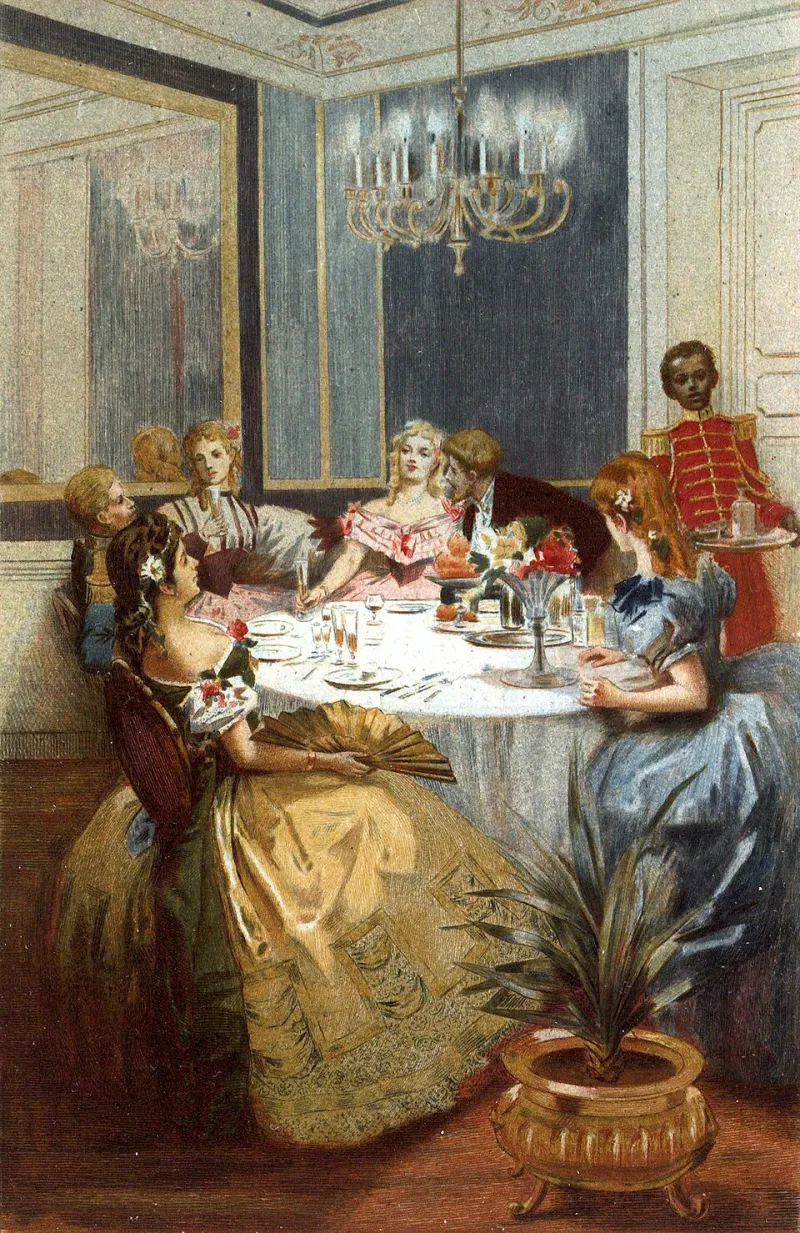
Photo: Albert Lynch, Public domain, via Wikimedia Commons
Every country has a word it borrows when it wants to sound more sophisticated than it feels. For America, that word has been French for the better part of two and a half centuries. It is stitched into labels, painted onto storefronts, and whispered into marketing copy with the confidence of a password that always works. But the word had to start somewhere — and, perhaps surprisingly, it started with a man who never sold a single garment.
The General Who Never Sold a Dress
The Marquis de Lafayette was a nineteen-year-old French aristocrat when he defied his king to sail to South Carolina and join the American Revolution. He fought at Brandywine, endured the winter at Valley Forge, and helped corner the British at Yorktown. When he returned to the United States for a triumphal farewell tour in 1824, he was received less as a foreign dignitary than as a member of the family. Streets, squares, and entire cities took his name — from Fayetteville, North Carolina, to the grand avenue on Manhattan's East Side.
Here is what matters for anyone who cares about clothes: Lafayette became the first French name that Americans loved collectively. Before there was a French fashion house on American soil, there was a French hero on American maps. The idea that France could stand for something America admired — courage, refinement, a certain stylish refusal to be ordinary — was established long before the first couture label crossed the Atlantic.
From Avenue to Awning
The twentieth century did the rest. As Paris consolidated its position as the world's fashion capital, American retailers learned that the word French could do quiet, remarkable work. A plain dress became a French dress. A department store basement became a boutique, a French word that made browsing feel like travel. Even the vocabulary of shopping itself — atelier, couture, prêt-à-porter, chic — arrived as a kind of elegant import duty on the language.
This was never exactly deception. It was diplomacy of a commercial kind. When an American designer in the 1930s or 1950s invoked Paris, they were borrowing authority the way Lafayette had borrowed ships — with permission, more or less, and to mutual benefit. The French names gave American fashion a lineage it did not yet have; American retail gave French craft an audience of unprecedented size.
What the Word Signals Now
Walk down any main street in America today and you will find the inheritance intact. The word French on a sign promises something specific, whether or not the promise is kept: restraint over volume, craft over speed, a wardrobe meant to be worn for a decade rather than a season. The shopper who responds to that promise is not necessarily buying a product. She is buying a point of view — the belief that getting dressed is a form of thinking.
And yet the honest question, the one a serious fashion house should ask itself, is whether the word still carries its original weight. When French is applied indiscriminately — to fast fashion, to mass-produced accessories, to anything with a beret in the ad — it risks becoming mere seasoning, flavor added to disguise the absence of substance. A word earns its meaning through use; it loses that meaning through abuse.
Why the Name Still Matters
At Haus of Lafayette, the name was never an accident of branding. It is an argument. Lafayette stood for the productive friction between two cultures — French conviction in service of American possibility. That is precisely the space where the best American fashion lives today: the European tradition of cut and craft, held to American standards of practicality and self-invention.
So when you see a French name on an American door, do not ask whether it is authentic in the passport sense. Ask whether it is authentic in the Lafayette sense — whether the thing behind the door honors the exchange, whether it brings something genuinely elegant and something genuinely useful to the same table. The fantasy of France has dressed American dreams for two centuries. The fantasy holds up exactly as long as the clothes do.