Terrace Dressing: How Café Culture Became America's Most Wearable Aesthetic
Photo: Internet Archive Book Images, No restrictions, via Wikimedia Commons
There is a moment, usually around the second espresso, when it happens. You are seated on a sidewalk terrace—perhaps in the Marais, perhaps, more surprisingly, in Savannah—and you notice that everything around you seems designed to a single, unspoken brief: rattan bent into graceful curves, crisp striped cushions, a basket bag propped against a chair leg, linen catching the light in a way that feels entirely unbothered. The Parisian café terrace has always been a stage set. What is new is how many Americans have started dressing for the role.
From the Left Bank to the Boardwalk
The migration of café aesthetics into American wardrobes did not arrive by runway. It arrived by photograph. Over the past several years, the terrace tableau—that perennial fantasy of effortless European leisure—has become one of the most referenced visual touchstones in American style culture. Coastal cities led the charge. In Charleston and Savannah, where al fresco dining is practically a civic religion, the look felt like a natural extension of place. In Los Angeles, it merged with an existing devotion to relaxed tailoring. In New York, it was absorbed into the city's long-running romance with French dressing generally.
What makes the trend durable rather than disposable is its logic. The terrace look is, at its core, a uniform built for sitting outside for hours: breathable fabrics, forgiving silhouettes, accessories that double as props. It is clothing designed for the long lunch, and Americans—finally embracing the long lunch—have embraced it accordingly.
The Anatomy of the Look
Deconstructed, the terrace aesthetic rests on a handful of reliable elements.
Woven texture. Rattan, raffia, and caning appear first in the furniture and inevitably migrate to the accessories: the basket bag is the movement's signature carryall, practical enough for a farmers market and photogenic enough for everything else.
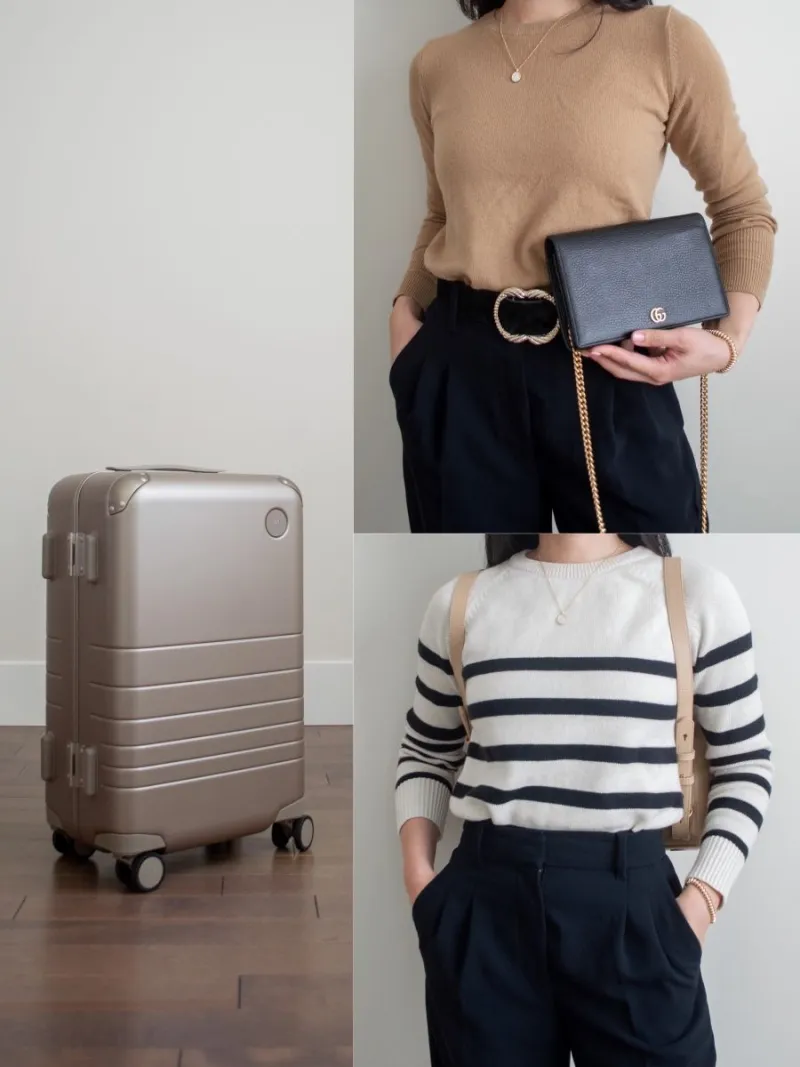
Stripes. The Breton stripe has been an American staple since the 1950s, but its current iteration skews broader—awning stripes, deck-chair stripes, tablecloth stripes—applied to shirting, knitwear, and occasionally both in a single outfit.
Linen, unapologetically wrinkled. The terrace look grants formal permission to crease. A linen shirt that reads rumpled rather than neglected is the entire thesis of the aesthetic.
Warm neutrals. Cream, ecru, olive, and faded navy dominate, punctuated by the occasional pop of tomato red or Provençal yellow.
Avoiding the Costume Trap
Here is where American interpretation matters. Worn head to toe, the terrace look risks tipping from homage into theme park—a concern anyone who has witnessed a bachelorette party in matching straw hats will understand. The remedy is restraint through mixing. Pair the basket bag with denim rather than linen trousers. Let the striped knit anchor an outfit of thoroughly American pieces: straight-leg jeans, leather sneakers, a trench. One or two terrace signifiers per outfit is a citation; five is a reenactment.
Consider, too, provenance. A raffia tote woven by a Madagascar-based cooperative carries the same silhouette as a mass-produced version but with an entirely different weight. The American shopper's growing insistence on knowing where things come from suits this aesthetic unusually well, since its appeal has always been rooted in craft.
A Short Shopping Guide
To build the look without the clichés:
- One woven bag, structured enough to hold its shape on a restaurant floor. Skip the miniature versions; the charm is in the utility.
- A striped long-sleeve knit in a substantial cotton—fine enough to layer, dense enough to hold a stripe.
- Linen in two weights: a relaxed shirt for warm months and a heavier blend for shoulder-season layering.
- Leather sandals or ballet flats, because the terrace look collapses on rubber flip-flops. Footwear is where the European half of the equation earns its keep.
- A scarf, worn at the neck or knotted to a bag handle. Optional, but it is the single fastest route to the vibe.
The Deeper Appeal
It would be easy to file this under trend cycle and move on, but the terrace aesthetic touches something more durable. It is a style built around leisure as an act of intention—around the idea that sitting still, outdoors, in good light, with a coffee, is a pursuit worth dressing for. European cities built that ritual into their architecture; Americans are building it into their calendars and, now, their closets.
The bistro chair, after all, was never really about the chair. It was about the permission to linger. If a striped shirt and a basket bag help more of us take that permission, the trend has done its work—and will likely outlast the season.