Customs, Declared: The Souvenirs That Quietly Redesign an American Wardrobe

Photo: John Nathan Cobb, Public domain, via Wikimedia Commons
There is a moment, somewhere over the Atlantic, when the suitcase becomes a manifesto. The American woman flying home from Paris is not merely transporting purchases; she is importing a point of view. Ask around any departure gate at Charles de Gaulle and the inventory repeats itself with striking consistency: a pharmacie haul of serums and thermal water, a leather handbag purchased after considerable deliberation, a stack of linen in colors that don't exist in American mall lighting, and perhaps—if she's done her homework—a pair of shoes from a brand she'd only read about online.
What happens next is the interesting part. Those items don't sit in a drawer labeled "vacation." They colonize the wardrobe. They raise the baseline.
The Pharmacy Run: Beauty as Souvenir
No traveler escapes the City of Light without standing in front of a pharmacie shelf, often one with the telltale green cross glowing above it. The French pharmacy has become a destination in its own right—an American ritual now so established that certain drugstores near Saint-Germain keep English-language signage stocked year-round.
The appeal is partly price, but mostly formulation. Micellar water that costs a fraction of its US markup, thermal spring water in an aerosol can, the cult-favorite sunscreens and hand creams that fill every French handbag. A hundred dollars spent at a Paris pharmacie can fill a toiletry bag for a season; the same haul at an American retailer often runs double.
The ripple effect is subtle but real. Women return having replaced a twelve-step routine with four products that actually work, and the simplification bleeds into how they dress. Fewer, better, gentler—it's a principle that transfers from skincare to closets with alarming speed.
Leather Goods: Where the Math Actually Works
Here the buyer's guide matters, because the gap between "genuinely better in Paris" and "tourist trap" is wide. European prices for French and Italian luxury houses are typically 15 to 25 percent lower than US retail, even after accounting for the current exchange rate and sales tax. France's détaxe—the VAT refund available to non-EU residents—recovers roughly 12 percent on qualifying purchases, provided you spend the minimum per store (around €100 at most houses), keep every receipt, and process the refund electronically at the airport before departure.
The practical guidance:
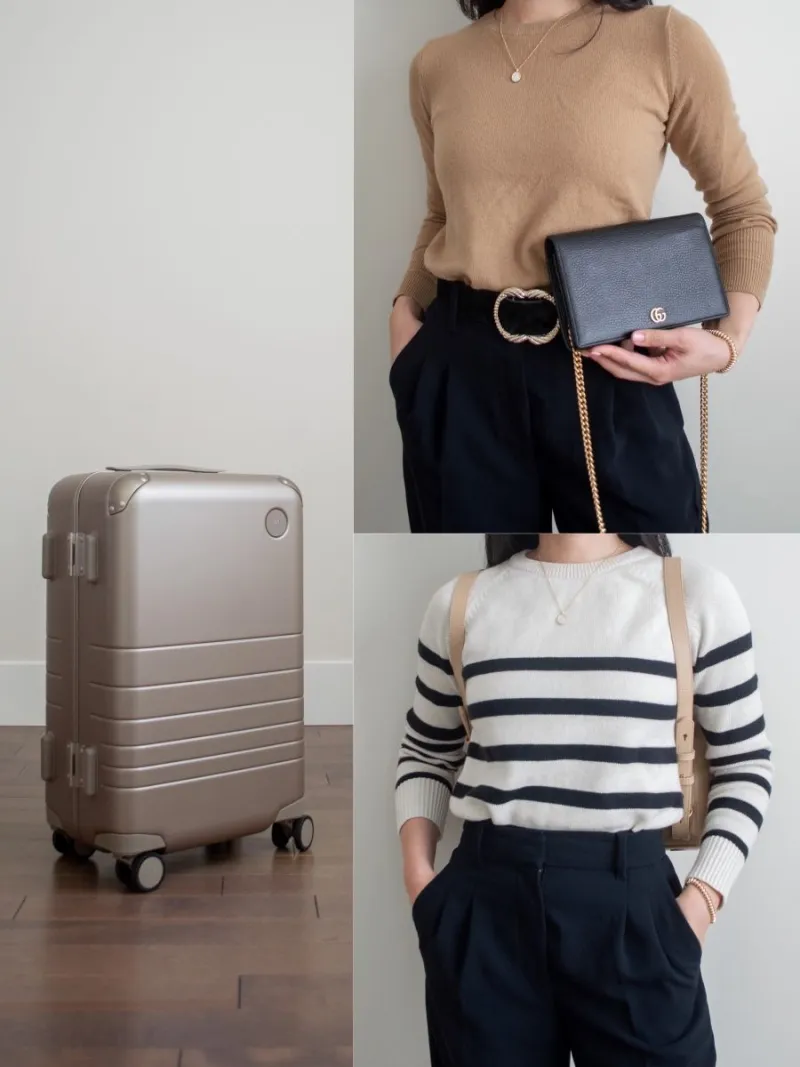
- Buy the investment piece abroad. A structured handbag from a heritage house, purchased in Paris with the VAT refund, can cost hundreds less than the identical bag in a New York boutique. This is the single strongest arbitrage in the transatlantic shopping equation.
- Skip the souvenir-adjacent leather. The stalls selling "genuine Italian leather" totes near major monuments are exactly what they appear to be. If the price feels like a deal, the leather isn't.
- Verify the refund process before you fly. The paperwork is digital now, but it must be validated at the airport kiosk—budget twenty minutes and don't check the bag containing your receipts.
Linen, Cotton, and the Fabric Problem
The textile haul is less about price and more about availability. European retailers—particularly those specializing in workwear-grade linen and garment-dyed cotton—offer cuts and weights that American fast fashion has largely abandoned. A linen shirt in Paris is likely to be heavier, better sewn, and cut for a body rather than a hanger.
The result, back home, is instructive. Women report that the Paris linen becomes the benchmark against which everything else in the closet is measured—and found wanting. This is, perhaps, the true function of the second suitcase: not the items themselves, but the standard they establish.
What to Leave Behind
A candid accounting requires the warnings. Novelty items with the Eiffel Tower on them are self-explanatory. Less obvious: mass-market clothing brands available in the US at comparable prices, where the only difference is the shopping bag. Berets, purchased by anyone who does not intend to wear a beret. And the vintage market, once a hunter's paradise, now requires genuine knowledge—prices in the Marais have risen to meet demand, and not every €200 dress is a find.
The Longer Return
Ask women a year out from the trip what changed, and the purchases are half the story. The other half is habit: checking fiber content labels, waiting for pieces rather than chasing trends, treating the closet as a curated collection rather than a storage unit. The second suitcase, in the end, is less a container of goods than a container of criteria—unpacked slowly, worn for years, and never quite checked at the gate.