Measured to the Millimeter: The Return of the Personal Fitting in American Fashion
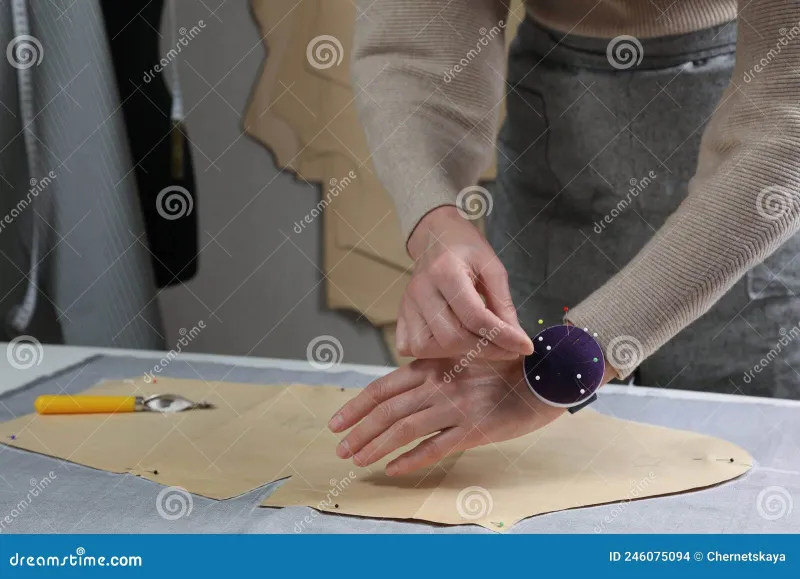
Photo: tailor pinning fabric during fitting in atelier fitting room, via thumbs.dreamstime.com
There is a moment in every fitting that cannot be photographed: the pause when a garment, pinned and chalked to your exact frame, finally settles onto the body the way it was always meant to. For generations, American women encountered that moment only in the rarefied corners of the fashion world — a bespoke salon on Savile Row's transatlantic cousins, a family tailor inherited rather than sought. Today, the pause is happening in strip-mall ateliers in Atlanta, converted lofts in Chicago, and video calls with pattern-makers in Lisbon. Made-to-measure is back, and this time it is not reserved for the few.
From Size on a Rack to Shape on a Body
The ready-to-wear system, for all its convenience, asks the body to conform to the garment. American sizing — notoriously inconsistent from label to label — reduces a person to a number that shifts depending on the brand, the season, even the factory. Made-to-measure inverts the equation entirely. The garment begins with you.
The distinction matters more than the terminology suggests. Bespoke, in its strictest sense, involves a unique pattern drafted from scratch and multiple fittings. Made-to-measure adapts a base pattern to individual measurements, typically requiring one or two appointments. Both sit a world apart from off-the-rack, where alterations — the hem here, the waist pinch there — are corrections rather than foundations.
What women describe when they wear their first commissioned piece is rarely vanity. It is relief. Sleeves that meet the wrist at precisely the right point. A shoulder seam that does not gape when reaching for a coat. A waistband that acknowledges the body's actual topography. The garment stops being something to manage and becomes something simply to wear.
The Technology That Opened the Door
The revival did not happen by accident. A convergence of forces has pulled custom clothing out of the atelier and into the mainstream.
Smartphone measurement apps, refined considerably over the past five years, now capture body dimensions with startling accuracy — often within a centimeter of a professional tailor's tape. Platforms connect American clients directly with pattern-makers in Porto, Kraków, and Paris, collapsing a process that once required overseas travel. Meanwhile, a generation of American small ateliers — many staffed by immigrants trained in European houses — has built thriving businesses on turnaround times measured in weeks, not months.
The economics have shifted too. A made-to-measure blazer from a reputable independent house now begins, in many cases, around the price of a designer label at a department store. The difference is that the money buys cloth, labor, and fit rather than marketing and margin.
The Visiting Cutter and the New Old-World Circuit
One of the more charming developments in the American tailoring renaissance is the return of the traveling fitter. European pattern-makers and cutters, particularly from Italy and Central Europe, now make regular circuits through New York, Los Angeles, Houston, and Washington, setting up in hotel suites and boutique back rooms for three-day engagements. Clients book an appointment, are measured, select cloth from swatch books, and receive their garments by post weeks later.
The model is a deliberate echo of an older tradition — the door-to-door tailor, the trunk show — updated with digital pattern libraries and shipping logistics. For the client, it offers something department stores cannot: a relationship. The cutter remembers that you prefer a softer shoulder. Notes that you carry your bag on the left. Adjusts the next commission accordingly.
Commissioning Your First Piece: A Practical Primer
For those considering a first commission, the experts offer consistent counsel.
Start with a workhorse. A blazer, a sheath dress, or a wool coat — something worn often enough to justify the investment and simple enough to showcase good fit.
Expect more than one appointment. Even made-to-measure typically involves a fitting mid-construction. Budget the time; the second fitting is where the magic concentrates.
Be honest about your life. A garment commissioned for the body you have, and the life you actually lead — commutes, car seats, cross-country flights — will be worn far more than one imagined for a hypothetical self.
Ask about the pattern. Reputable houses keep your measurements on file and will adjust future commissions. That archive, not the garment itself, is the true luxury: a wardrobe that improves with every order.
Understand the timeline. Six to ten weeks is standard. Rushing the process is the fastest way to compromise it.
Why the Second Fitting Feels Different
There is a reason the industry speaks of the second fitting with something approaching reverence. The first is arithmetic — measurements, posture, preferences. The second is where the garment and the person negotiate. A pin here, a release there, and suddenly the piece stops resembling a garment in progress and starts resembling your clothes.
European dressing has long understood this intimacy; the American closet is only now reclaiming it. The result is not a rejection of ready-to-wear but a rebalancing — a recognition that some things in a wardrobe deserve to be made for one body alone. In an era of endless scrolling and one-click buying, the appointment, the pins, the patience of a well-made thing arriving on its own schedule: these have become their own kind of elegance.
The rack will always have its place. But the fitting chair, it turns out, was never really gone. It was simply waiting for America to come back.