The Quiet Rebellion in Your Closet: How the French Capsule Wardrobe Is Rewiring American Shopping
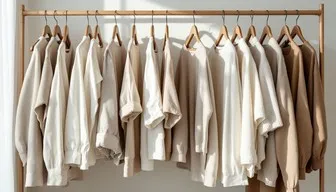
Photo: minimalist capsule wardrobe neutral clothing rack editorial, via images.stockcake.com
Somewhere between the collapse of a certain fast-fashion giant's reputation and the rise of the phrase 'cost per wear' in everyday conversation, something shifted in the American closet. It was quiet. It was unphotogenic. And it may prove to be the most significant change in how this country dresses in a generation.
Women are buying less. They are buying better. And they are borrowing the philosophy from a place that never stopped practicing it: Europe.
The Arithmetic of Elegance
Start with the math, because the math is unforgiving. A $40 blazer worn twelve times before the seam gives way costs $3.33 per wear — and then it's landfill. A $400 blazer worn two hundred times over five years costs $2 per wear, still looks impeccable, and can be resold, tailored, or handed down.
This is not a new calculation. French and Italian women have been running it instinctively for decades, which is why a well-dressed woman in Paris may own a fraction of what her American counterpart does — and look considerably more put together. The European wardrobe is not built on abundance. It is built on repetition of excellent things.
What's new is that American women are doing the arithmetic out loud.
From Haul Culture to Heirloom Culture
The shift has cultural roots as deep as the economic ones. A decade ago, the haul video — dozens of packages torn open for an audience — was the dominant fashion content in the US. Today, the algorithm increasingly rewards the opposite: the 'one in, one out' closet edit, the capsule wardrobe video, the thirty-something stylist explaining why she owns five pairs of trousers.
Boutique owners have noticed. Across the country, small retailers report customers walking in with a different question than they asked five years ago. It is no longer 'What's new?' It is 'What will I still wear in three years?' That question changes everything about what a store stocks and how a customer shops.
The stylists we spoke with describe a client base that has become fluent in construction — canvas vs. fused interfacing, full-grain leather, the difference between a garment that drapes and one that merely hangs. Fast fashion trained a generation to ignore these details. Quality is teaching them back.
The French Lesson, Translated
The so-called French philosophy — the five-piece wardrobe, the ten-year coat, the shoes resoled rather than replaced — is often romanticized into something unattainable. It shouldn't be. At its core, it is simply a different relationship with desire.
The American retail machine is engineered around impulse: the flash sale, the free shipping threshold, the cart abandoned and recovered with a discount code. The European model, particularly as practiced by the French, treats clothing as something closer to furniture — purchased deliberately, maintained carefully, and lived with for years.
Translating that to the US doesn't require renouncing American style. Our best-dressed women have always blended the two: the European investment piece as foundation, the American flair as accent. A beautifully made trench, worn for a decade, styled with the urgency of a New York morning — that is the hybrid, and it is arguably the most distinctive look this country produces.
The Honest Objections
It would be dishonest to pretend the philosophy is universally accessible. A $500 coat is not a moral choice; for many women, it is simply not on the table. The buy-less-buy-better movement deserves scrutiny when it drifts into condescension.
But the principle scales. Buying one good thing instead of four mediocre ones works at nearly every budget. Shopping secondhand — a booming sector precisely because quality goods hold value — makes the philosophy accessible in a way it never was. And the most radical version costs nothing at all: wearing what you already own, repeatedly and unapologetically, until the cost per wear approaches zero.
The Case, Plainly Stated
Here is the argument, stripped of romance: fast fashion externalizes its costs onto garment workers, waterways, and landfills, and delivers garments that age badly. Slow fashion internalizes those costs into a higher price — and delivers garments that age beautifully. The first model asks you to keep paying. The second asks you to pay attention.
Elegance, it turns out, was never about the quantity of the wardrobe. It was about the certainty within it. The French understood this all along. American women, in growing numbers, are deciding they understand it too — one deliberate, well-made, long-lived piece at a time.
The closet, in other words, is no longer where the impulse lives. It's where the intention does.