Fifteen Minutes to Milan: Effortless European Polish for the American Morning

Photo: elegant woman tailored blazer coat walking city street morning style, via img.freepik.com
There is a persistent myth on both sides of the Atlantic that European women wake up at dawn to assemble their looks — that Milanese polish is the product of hours in front of a mirror and a walk-in closet the size of a Tribeca studio. In truth, the opposite is closer to the mark. The women who look most put-together in Milan, Paris, or Copenhagen are often the ones who decided what to wear in the time it took their espresso to pull.
For the American woman juggling a commute, a carpool line, and a coffee meeting that somehow landed at 8 a.m., that is the real lesson worth importing. Polish is not a time investment. It is a system.
Why the Formula Beats the Outfit
American wardrobes tend to be organized around occasions: the work outfit, the weekend outfit, the dinner outfit. European wardrobes, by contrast, are organized around formulas — repeatable combinations of two or three pieces that always work together. The formula removes decision fatigue, and decision fatigue is what makes a morning feel rushed and a look feel frantic.
Stylists who work with American clients on European-leaning wardrobes tend to start in the same place: audit the closet not for what you own, but for what combinations you own. Three great pieces that never meet each other are worth less than three good pieces that always do.
The Three Formulas That Do Everything
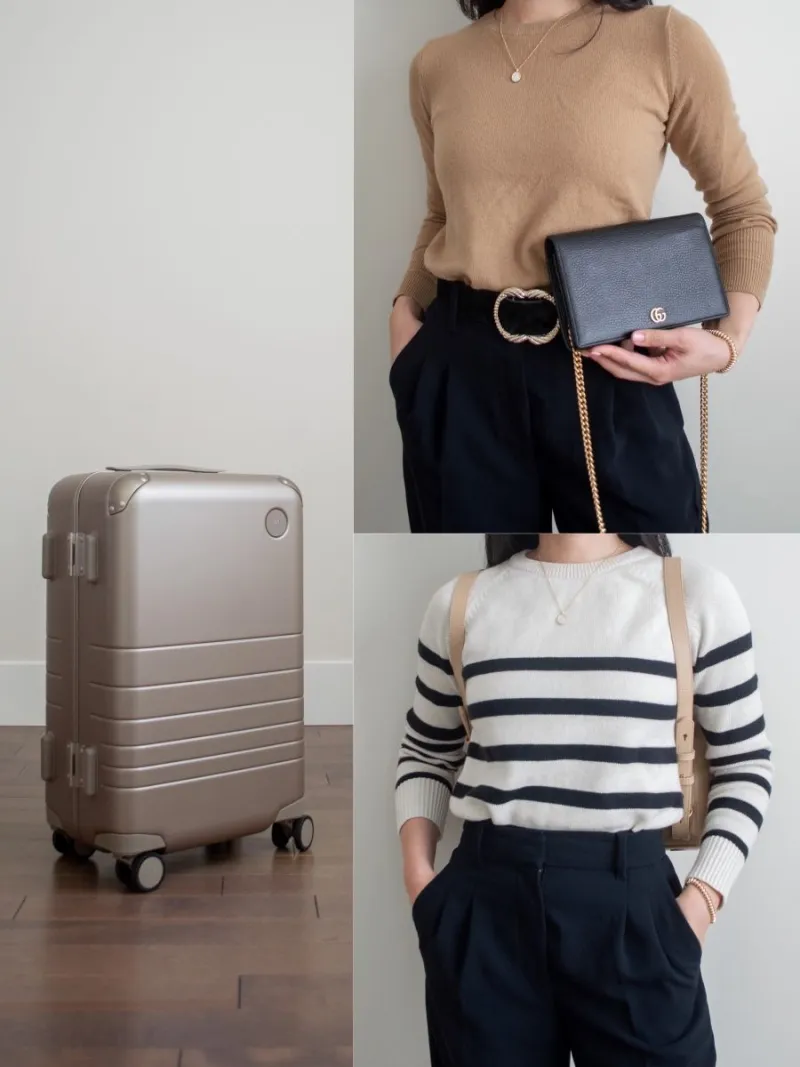
The Tailored Base. Straight-leg trousers, a fitted knit top or fine-gauge turtleneck, and a structured coat or blazer. This is the workhorse. It survives the commute, reads as authority on a video call, and transitions to lunch without a single adjustment. Keep the palette neutral — camel, navy, charcoal — and let one accessory, a scarf or a leather belt, carry the personality.
The Elevated Uniform. A midi skirt or dark denim paired with a crisp button-down, sleeves pushed just past the elbow. Add loafers or low block heels. This is the formula for the school run that flows into a client meeting. The button-down does the heavy lifting: ironed, it is formal; slightly lived-in, it is approachable. Choose one and commit.
The Third-Piece Rule. Whatever the base — dress, jeans and tee, trousers and knit — add a third structured piece: a blazer, a trench, a long cardigan with weight to it. European dressing is, at its core, a game of layers with architecture. The third piece is what separates dressed from wearing clothes.
The Fifteen-Minute Rule
Here is the discipline: if assembling tomorrow's look takes longer than fifteen minutes tonight, it is not the right look. Lay it out the evening before — shoes included, coat included. If you find yourself deliberating, swap in a formula piece. The formulas exist precisely so that deliberation becomes unnecessary.
Fifteen minutes is also a useful ceiling for morning grooming on this system. The European look favors one point of emphasis — a strong lip or a considered hairstyle, rarely both at full volume — which conveniently aligns with the realities of an American morning.
What the Stylists Say
Ask stylists who translate Milanese and Parisian dressing for American clients and a theme emerges: the gap is rarely the clothes. It is the finishing. American wardrobes are often one gesture away from polish — a hem taken up properly, a coat swapped for a jacket, a bag emptied of its clutter so it holds its shape.
Their advice converges on three points. First, tailoring is non-negotiable; a $90 pair of trousers altered to fit will outperform a $900 pair that doesn't. Second, shoes and bags carry the outfit — Europeans spend disproportionately there, and it shows. Third, restraint is the shortcut: fewer pieces, worn more often, in better condition.
The Week, Mapped
Monday: tailored base, camel coat. Tuesday: elevated uniform with loafers. Wednesday: dress plus third piece. Thursday: denim, button-down, trench. Friday: the formula you loved most, repeated without apology.
Notice that repetition is in the plan. Europeans repeat outfits openly and without embarrassment; the American habit of treating a repeat as a small defeat is perhaps the single most exhausting export of fast-fashion culture. Wear it again. It looked right the first time.
The Real Point
Milan on a lunch break is not about pretending you live in Italy. It is about borrowing the operating system — formulas over outfits, structure over fuss, fifteen minutes over an hour — and running it on an American schedule. The school run and the coffee meeting were never the obstacles. They were the runway all along.